Article
18 min
read
Building Voice AI Agents That Deliver Real Value for CCaaS and Call Centers
Customer expectations for call center technology have never been higher.

Chris Grillone
EVP, Commercial Strategy & Growth


Customer expectations for call center and contact center as a Service (CCaaS) solutions are rising — they want interactions that are fast, natural, and useful while lowering operational costs. Voice AI agents can automate common interactions, reduce customer wait times, and boost satisfaction when they handle real conversations with low latency and real-time data integration. This article explains how programmable voice AI agents built on SignalWire’s platform help CCaaS providers and contact centers deliver measurable business value, accelerate development, and scale without sacrificing quality.
Voice AI has crossed an important threshold.
It’s no longer impressive that an AI agent can answer a phone call, transcribe speech, or respond with a synthesized voice. Those capabilities are table stakes. What matters now is whether voice AI actually improves outcomes for call centers and Contact Center as a Service (CCaaS) platforms.
Most deployments don’t.
They demo well, fail quietly in production, and end up being bypassed by agents or disabled altogether. The gap between “AI that works in a demo” and “AI that delivers real value” is wider than most teams expect
At SignalWire, we designed our Voice AI Agent API and developer-first Programmable Unified Communications(PUC) platform to solve this exact problem.
Faster time-to-market with voice AI agents
Developers supporting call centers don’t just need another prefab solution, they need programmable voice AI Agents they can shape for their own customer use cases. With SignalWire, teams can:
Spin up data-driven IVRs in minutes using Datasphere, our own Retrieval-Augmented Generation (RAG).
Scale to complex customer interactions, seamlessly integrating with CRMs, ERPs, or ticketing systems to resolve real business problems.
Accelerate launch timelines, cutting weeks or months off development cycles so your customers see value sooner.
The outcome: faster time-to-market, reduced costs of delivery, and the ability to delight end users with responsive and intelligent interactions.
What “real value” actually means in CCaaS environments
In a CCaaS or contact center context, “value” is not abstract.
A voice AI agent is valuable if it:
Resolves common requests without human intervention
Routes callers correctly the first time
Reduces agent workload without increasing customer frustration
Behaves consistently across thousands of simultaneous calls
Fails safely when it does not know what to do
Anything else is a science experiment.
This is why many voice AI deployments quietly degrade into glorified IVRs or are relegated to handling only the safest edge of the call volume.
Voice AI Agents done right don’t just automate calls; they drive measurable business outcomes. With SignalWire's platform, CCaaS providers and enterprises can:
Increase revenue by making customer interactions seamless and reducing call abandonment.
Lower operational costs by automating high-volume, repetitive interactions without sacrificing quality.
Boost satisfaction and retention by delivering natural, human-like conversations that meet customers where they are.
Customers won’t wait for laggy or robotic systems. That’s why low latency and natural interaction are at the heart of what we build.
Why scripted bots and chat-style voice agents break down
Many voice AI systems are built by adapting chatbot patterns to voice.
That works poorly.
Chatbots assume:
Asynchronous interaction
Visible context
User patience
Easy correction
Voice interactions are:
Real-time
Ephemeral
Interruptible
Unforgiving of latency or confusion
Scripted flows collapse under real conversational variance. Chat-style agents struggle with turn-taking, interruptions, and ambiguity. The result is an experience that feels brittle, slow, or frustrating, especially when callers deviate even slightly from the expected path.
This is not a prompt problem. It’s an architectural one.
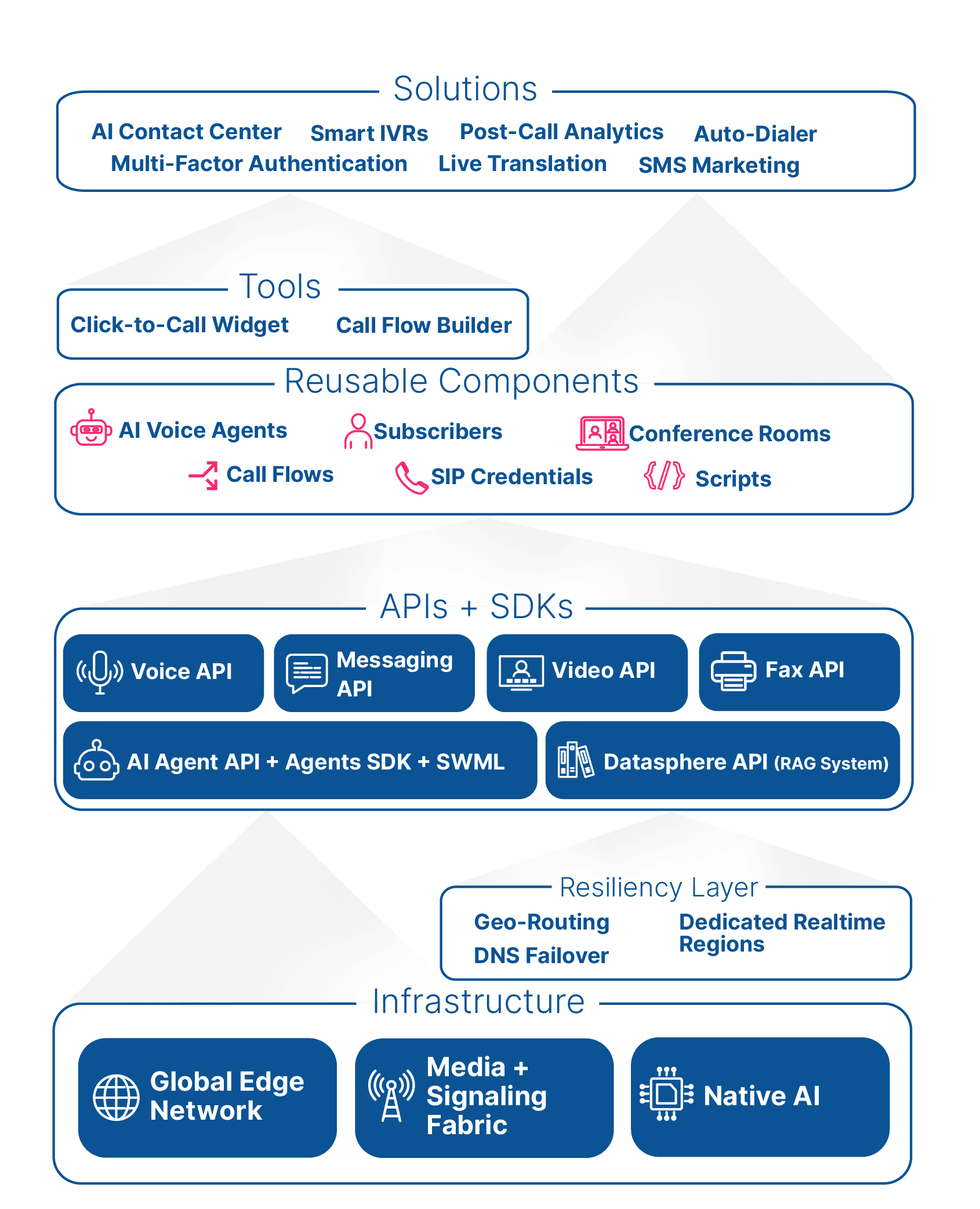
SignalWire is the only communications platform with AI embedded directly in the telecom stack. With our proprietary SignalWire AI Gateway (SWAIG) and Datasphere RAG API, we deliver:
Ultra-low latency (~900ms round trip) for a truly human-like experience.
Programmable Unified Communications (PUC) across SIP, PSTN, WebRTC, and messaging, so developers can build once and scale everywhere.
End-to-end developer tooling, including the Developer Toolkit, which gives hands-on examples, templates, and SDKs to build and deploy faster.
Low latency is the difference between automation and abandonment
Latency is not a performance optimization in voice AI. It is the experience.
When responses lag, callers interrupt. When interruptions aren’t handled cleanly, conversations fall apart. When conversations feel unnatural, callers opt out or demand a human.
Sub-second end-to-end latency is the difference between:
An AI agent that feels present
And one that feels broken
This is why voice AI cannot be bolted on as an afterthought. The telecom layer, media handling, and AI inference must be tightly integrated
Orchestration matters more than which model you choose
Most teams over-index on the large language model.
In practice, the model is rarely the bottleneck.
What determines success is:
How state is managed during a call
How decisions are sequenced
How failures are handled
How tools and actions are invoked
How multiple systems coordinate in real time
Orchestration defines whether an AI agent behaves like a reliable system or a probabilistic suggestion engine.
This is why swapping models rarely fixes broken voice AI deployments. The problems live above the model layer.
The Developer Toolkit: From idea to production, faster
We know that developers need more than just APIs; they need working code, tested examples, and guidance. That’s why we’ve invested in the SignalWire Developer Toolkit, a growing library that helps developers move from concept to production-grade solutions with less friction.
Whether you’re building a lightweight IVR or a multi-step call center workflow that integrates external systems, the toolkit demonstrates best practices and accelerates development so you can deliver real Voice AI Agent solutions, not just prototypes.
The future of call centers depends on human-like Voice AI Agent experiences that scale. SignalWire enables you to:
Build programmable Voice AI Agents that don’t just sound intelligent but actually resolve customer issues.
Bring your own AI or use our AI, without worrying about the complexities of telecom or latency.
Deliver real, measurable business outcomes faster.
For developers and product owners, that means more innovation, less friction, and a platform you can rely on.
At SignalWire, we’re proud to empower developers and product teams to deliver Voice AI Agent solutions that increase revenue, lower costs, and boost customer satisfaction. With our AI Gateway, RAG engine, and Developer Toolkit, we make it possible to go from concept to live production faster than ever before, all on a full-stack platform built for Voice AI Agents.
The future of CCaaS and Contact Center technology is Programmable Unified Communications, and we're here to help you build it.
Ready to build? Get started today with the SignalWire Developer Toolkit and bring your Voice AI Agent to life faster.
Need more guidance? Talk to our team to see how SignalWire can accelerate your CCaaS and call center innovation.
Frequently asked questions
What is a voice AI agent in a call center?
A voice AI agent is an intelligent virtual assistant that uses speech recognition and natural language understanding to automate or augment live agent interactions in a contact center.
How do voice AI agents reduce operational costs?
By automating high-volume, repetitive interactions like FAQs, appointments, or status updates, voice AI agents reduce the workload on human staff, letting centers operate efficiently at scale.
Why is low latency important for voice AI?
Low latency — short round-trip times between user speech and the AI response — is essential for natural, human-like conversations. High lag makes interactions feel robotic and degrades user experience.
What is retrieval-augmented generation (RAG) in voice AI?
RAG lets a voice AI agent fetch real-time information from external systems — like CRM or ticketing databases — so responses are accurate and context-aware during live conversations.
Can voice AI agents integrate with existing CCaaS platforms?
Yes. Using APIs, SDKs, and developer tools, AI agents can integrate into most CCaaS or call center environments without replacing core infrastructure.
Related Resources